Your CRM is a graveyard.
Buried in there are leads that once looked promising. People who filled out your form, clicked your ad, maybe even got on a call with your team. Then went quiet. Your reps moved on. Life happened. And now those contacts just sit there, untouched, collecting digital dust while you spend money chasing new ones.
Here’s what most teams get wrong: the leads aren’t dead. You just stopped talking to them.
The old follow-up playbook — sporadic emails, manual call attempts, a “just checking in” message that nobody reads — was already failing three years ago. Today’s prospects expect faster responses and personalized interactions. They engage on channels they actually open. Anything else and you’ve lost them permanently.
WhatsApp is that channel. With 98% open rates, it’s not competing with email. It’s in a different category. And when you pair that reach with automation that actually knows who it’s talking to, you can re-engage cold leads at scale, get the right message in front of them at the right moment, and hand your sales team prospects who are already ready to move.
This guide shows you exactly how to do that.
What Is a WhatsApp Chatbot?
A WhatsApp chatbot sends and receives messages automatically, without a human on the other end. It holds thousands of conversations at once, responds instantly, and doesn’t take Sundays off. Not a novel concept. What makes it different is where it runs and what it actually does with a reply.
Unlike an email broadcast, it creates two-way conversations. A lead engages at 2am and gets a response at 2am. That alone changes the conversion math.
How a WhatsApp Chatbot Works
Three mechanisms do the work.
Automation triggers watch for specific events and act. A lead silent for 30 days gets a re-engagement message. Someone who taps “pricing” gets the information instantly, with no rep involved and no ticket queued.
Conversational flows handle the branching. A lead who replies “Yes, I’m interested” follows a different path than one who says “Not right now.” The messages feel personal because they’re built on what the lead actually said, not a one-size-fits-all script.
CRM integration closes the loop. Response rates, qualification status, conversation history — all of it lands in your CRM before your sales team ever picks up the phone. They go in warm, not blind.
Why WhatsApp Works So Well for Re-Engagement
Most marketers treat WhatsApp like a faster email channel. That’s the wrong mental model entirely.
The numbers are brutal. The average email sits at 20-30% open rates. WhatsApp runs at 98% open rates. That’s not a marginal improvement. Most of your email list is ignoring you. Your WhatsApp messages are actually being read.
The context is different. People don’t expect brands on WhatsApp. It’s where they text their family, coordinate dinner plans, share voice notes at 11pm. A message landing there feels like a direct reach-out, not a campaign. That perception gap is what drives the response rates.
The reach is global. Over 2 billion active users. Whether your leads are in the US, Europe, or Southeast Asia, they’re already checking WhatsApp daily — probably more than their inbox.
That’s the case for WhatsApp chatbot automation: the right message, on the channel people actually trust, reaching leads who long ago stopped opening your emails.
Why Leads Go Cold (And Why Email Can’t Fix It)
Most leads don’t go cold because they lost interest. They go cold because you were too slow, too generic, or just easy to ignore. And if your re-engagement strategy is built on email, you’re probably committing all three mistakes in the same send.
The Speed Problem
You’re shopping for a service. You fill out a form. Then nothing. An hour passes. Then a day. By the time someone reaches out, you’ve already booked a call with whoever responded in minutes.
That’s what’s happening to your leads. Response rates drop 80% when follow-up takes longer than five minutes, yet most companies take hours. The lead didn’t go cold on their own. You left them there.
A WhatsApp chatbot fixes this at the source. The moment a lead enters your system, a message goes out. No queue, no delay, no “sorry for the late reply.”
The One-Size-Fits-All Problem
You’ve seen this email. You’ve ignored this email. “We noticed you haven’t responded. Are you still interested?” It reads like a form letter because it is one.
Sending the same message to every inactive lead tells your prospect one thing: you have no idea who they are. A solar lead and an HVAC lead have completely different concerns. A B2B buyer and a B2C customer are in entirely different headspaces. Generic outreach doesn’t just underperform. It signals that nobody’s actually paying attention.
A WhatsApp chatbot segments your leads and speaks to each one directly. A solar prospect gets: “Hi Sarah, still thinking about reducing your energy bills?” An HVAC lead gets: “Hi Rick, any questions about your heating system quote?” That small shift in personalization increases re-engagement rates by 26%. People respond when the message sounds like it was written for them, not at them.
The Inbox Problem
The average professional receives 121 emails per day. Your re-engagement email competes with invoices, newsletters, Slack notifications forwarded to email, and fifteen other things before 10am. Most prospects never see it. It gets buried, skimmed, or auto-sorted into a folder they open twice a year.
The message didn’t fail. The channel failed it.
WhatsApp operates differently. Fewer messages, sharper attention, and a direct line to someone’s phone rather than their overflowing inbox.
The Timing Problem
A great message sent at the wrong moment gets ignored. A re-engagement note at 7am when your prospect is half-asleep, or at 2pm when they’re back-to-back in meetings, doesn’t land because they don’t care — it doesn’t land because nobody’s there to receive it.
Traditional email campaigns send to everyone at once and hope for the best. A WhatsApp chatbot can reach each prospect at the moment they’re most likely to respond. More advanced systems use AI to predict the optimal re-engagement window based on individual behavior.
The right message on the right channel at the right time. That combination actually converts.
How a WhatsApp Chatbot Re-Engages Inactive Leads
Step 1: It Reaches Out Before You Even Think To
You don’t have to track which leads have gone quiet. The chatbot does that. The moment a lead hits a specific trigger — inactive for 30 days, visited your pricing page, opened an email but never replied — a personalized message goes out automatically.
Take Marcus. He visited your solar panel pricing page 45 days ago, then disappeared. Before your sales team notices, the chatbot has already sent: “Hi Marcus, I noticed you checked out our solar panel pricing. Still exploring options? I can answer any questions you have.”
Relevant, timed to the right moment, no rep required.
Step 2: It Personalizes at a Scale No Human Can Match
Manually personalizing follow-ups for hundreds of cold leads isn’t realistic. For a chatbot, it’s just Tuesday.
The chatbot references what each lead looked at, what they expressed interest in, and where they dropped off. The messages feel specific rather than scripted.
An HVAC lead gets: “Hi Rick, you requested a quote for your commercial HVAC system. That quote is still valid — want to move forward?”
An ecommerce lead gets: “Hi Sarah, your cart is still waiting. I found a 15% discount code just for you. Ready to complete your purchase?”
Same technology. Completely different conversations.
Step 3: It Qualifies Leads Through Conversation
No lengthy forms. No “book a call to find out more.” The chatbot qualifies leads the way a good salesperson would: by asking the right questions and actually listening to the answers.
Chatbot: “Are you still interested in solar panels?” Lead: “Maybe, but I’m not sure about the cost.” Chatbot: “What’s your typical monthly energy bill?” Lead: “Around $150.” Chatbot: “Based on your usage, we could save you 40% annually. Does that interest you?” Lead: “Yes, let’s talk.”
By the time your sales team steps in, this lead is already warm, informed, and moving toward a decision.
Step 4: It Nurtures Over Time, Not Just Once
A single follow-up rarely converts a cold lead. The chatbot accounts for this. It runs structured sequences that keep showing up with value until the lead re-engages or makes it clear they’re done.
A 7-day sequence looks something like this:
Day 1: “Still interested in [product]? I can answer any questions.”
Day 3: “Here’s what other customers like you saved with [solution].” (social proof)
Day 5: “Quick question: What’s holding you back from moving forward?”
Day 7: “This is my last message but your offer expires soon. Ready to talk?”
Each message has a job. Each one moves the conversation one step further. By Day 7, you have a clear answer: they’re ready, or they’re not the right fit right now. Both outcomes save your sales team time they would have spent guessing.
6 WhatsApp Chatbot Strategies That Actually Reactivate Cold Leads
Most chatbot re-engagement campaigns fail for the same reason: someone built automation and called it a strategy. The six approaches below are what separate a chatbot that actually brings leads back from one that just burns your list faster.
Strategy 1: Segment Before You Send
Sending the same message to every inactive lead doesn’t just underperform. It tells every lead on your list that you have no idea who they are.
Split your leads into groups before a single message goes out.
By time inactive:
- 30 days quiet: Still warm. A gentle nudge is enough.
- 60 days quiet: Lead with something new. “We’ve updated our offer” works well here.
- 90+ days quiet: This is your last shot. Write like it.
By behavior:
- Opened your email but didn’t click: Try a completely different angle.
- Viewed your pricing page but never requested a quote: Address the price hesitation directly.
- Started a form but abandoned it: Offer a simpler way back in.
A 30-day inactive lead doesn’t need urgency. A 90-day inactive lead does. Same message, very different outcomes.
Strategy 2: Start Soft, Not Salesy
Most businesses re-engage by coming back with a pitch. That’s usually why the lead went quiet in the first place.
Your first message should feel like a check-in, not a close. Try openers like these:
- “Hey [Name], still considering [solution]? Happy to answer any questions.”
- “I wanted to circle back on your [product] inquiry. Anything I can clarify?”
- “Quick question: Is timing still an issue, or did your needs change?”
- “We’ve made some updates since we last spoke. Thought you’d want to know.”
None of these ask for anything. They open a door. Once the lead responds, you can move the conversation toward value and eventually a decision.
Strategy 3: Lead With Value, Not a Request
People re-engage when they see something in it for them. If your message reads like “buy from us,” it gets deleted. If it offers something useful, it gets a reply.
Value-first messages that work:
- “I found a case study of an [industry] company that cut costs by 40% using [solution]. Interested?”
- “We just released an updated pricing guide. Want me to send it over?”
- “I noticed [competitor] raised their prices 20%. Ours haven’t changed. Still interested?”
- “We have a limited-time discount for customers like you. Want the details?”
Value first, ask second. Every time.
Strategy 4: Use Conversation to Re-Qualify
WhatsApp is a two-way channel. Use it to find out why the lead actually went quiet, not just to push another message at them.
Ask questions that surface the real objection:
- “Is timing still an issue, or has your situation changed?”
- “Are you still working on [project], or did priorities shift?”
- “What would need to happen for this to make sense for you right now?”
- “Is budget the main concern, or are there other factors?”
A lead who says “Timing is the issue, but we’re budgeting for Q2” isn’t cold. They’re scheduled. Your sales team now knows exactly when to follow up. A lead who says “We went with a competitor” is done, and you can stop spending time on them. Both answers save time. Most businesses never get either one because they never ask.
Strategy 5: Don’t Rely on WhatsApp Alone
WhatsApp is your strongest re-engagement channel, but it works better as part of a coordinated sequence than on its own.
WhatsApp + SMS: Send the WhatsApp message first. No response after three days, follow up via SMS. Lower open rate, but it catches people who aren’t active on WhatsApp.
WhatsApp + Email: Use email for the heavy content (case studies, detailed pricing breakdowns). Use WhatsApp for the personal follow-through: “I sent you a detailed case study via email. Worth a look — I think it’ll be relevant.”
WhatsApp + Phone Call: After two or three WhatsApp messages with no reply, have a sales rep call. The lead has already seen your name on WhatsApp, so the call lands less cold.
This multi-channel approach can increase re-engagement rates by 35-50% compared to relying on a single channel.
Strategy 6: Automate a Full Follow-Up Sequence
One message rarely converts a cold lead. The most effective re-engagement campaigns run 3 to 7 touchpoints over one to two weeks. The key is building the sequence once and letting it run, so no lead falls through because someone forgot to follow up.
Here’s a proven structure:
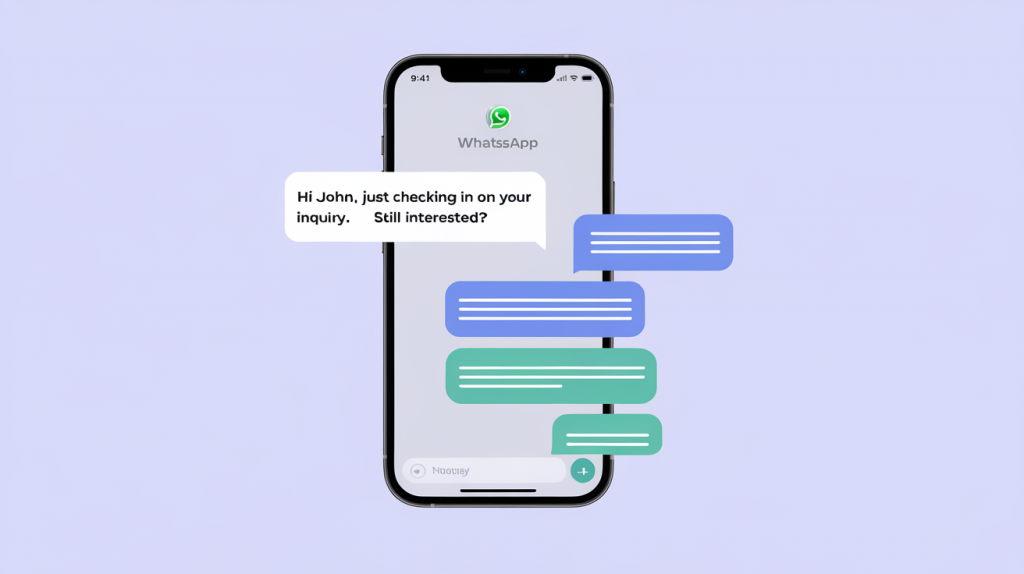
Day 1 (Soft Re-Entry): “Hi [Name], just checking in on your [product] inquiry. Still interested?”
Day 3 (Value Nudge): “Wanted to share something relevant: [case study/success story]. See if it applies to your situation.”
Day 5 (Objection Address): “Quick question: What’s the main thing holding you back from moving forward?”
Day 7 (Urgency): “Your quote expires in 3 days. Want to schedule a quick call to discuss?”
Day 10 (Final Offer): “Last message: We have a limited-time offer for customers like you. Interested?”
By Day 7, every lead in your sequence has shown you exactly where they stand. The ones who engage go to your sales team. The ones who don’t are off the list. No guessing, no wasted follow-up calls, no leads rotting in the CRM for another quarter.
WhatsApp Chatbot vs Traditional Follow-Up Methods
How does a WhatsApp chatbot compare to the old way of doing things? Let’s look at the numbers:
| Metric | Traditional Follow-Up | WhatsApp Chatbot |
| Response Time | 2-24 hours | Instant |
| Open Rate | 20-30% (email) | 98% |
| Response Rate | 5-15% | 25-40% |
| Cost per Lead | $5-20 | $0.50-2 |
| Personalization | Generic templates | AI-powered, individualized |
| Scalability | Limited by team size | Unlimited |
| Lead Qualification | Manual (time-intensive) | Automated (immediate) |
| Compliance | Manual tracking | Automatic audit trails |
Metrics to Track When Using a WhatsApp Chatbot
You can’t improve what you don’t measure. These five numbers tell you whether your re-engagement campaign is working or just running.
Open rate should sit at 90% or above. If it’s lower, something is wrong upstream: your send timing, your first message, or your list quality. Don’t optimize the sequence before you fix the entry point.
Response rate measures how many leads actually reply. Target 25-40% for re-engagement campaigns. Below 20% means your messaging isn’t landing. Not “could be improved.” Not landing.
Re-qualification rate is distinct from response rate and most people conflate the two. A lead who replies “Not interested anymore” is a response. It’s not a re-qualification. Track separately: what percentage of leads who respond indicate they’re still in play.
Conversion rate is the number that actually matters to your business. Of the leads who re-engage, how many become paying customers? This is your ROI metric. Everything else feeds into it.
Cost per reactivated lead gives you the business case. Take the total cost of your WhatsApp chatbot (software, setup, management) and divide by the number of leads successfully reactivated. For most businesses, this lands between $0.50 and $2 per lead — a fraction of what new lead acquisition costs.
5 Mistakes That Will Quietly Kill Your Re-Engagement Campaign
A WhatsApp chatbot can be a real competitive advantage. Set it up wrong and it becomes the reason leads block you permanently.
Mistake 1: Automating Everything and Personalizing Nothing
This is the most common way chatbot campaigns fail. You build the sequence, hit launch, and send the exact same message to every lead regardless of what they looked at, what industry they’re in, or where they dropped off.
From the lead’s perspective, it’s obvious. Obvious automation gets ignored.
Your chatbot should reference previous interactions, mention specific products, and adapt based on context. A generic “Hey, still interested?” is easy to dismiss. “Hi Marcus, still exploring solar options after checking out our pricing?” is harder to ignore.
Mistake 2: Messaging So Much You Become the Problem
Ten messages in seven days is firmly on the wrong side of persistent. Leads who feel bombarded don’t convert. They block, report, and move on.
Keep your sequences to 3 to 5 touchpoints spread across 7 to 14 days. Give people room between messages. Restraint here is a strategy, not a concession.
Mistake 3: Skipping Opt-In Compliance
Skipping consent doesn’t just expose you to bad results. It can get your account banned.
WhatsApp requires explicit permission before you message anyone. Reaching out to leads who never opted in violates WhatsApp’s terms of service, and the consequences are not worth the shortcut. Build your list right, or risk losing the channel entirely.
Mistake 4: Leading With the Sale
If your opening message is a pitch, you’ve already lost. Leads went cold for a reason — they felt pressured, didn’t see enough value, or simply weren’t ready. Coming back with “Buy now!” confirms every reservation they already had.
Start with a check-in. Build some trust. The pitch has its place, but it’s never the first message.
Mistake 5: Running WhatsApp in Isolation From Your CRM
A chatbot that isn’t synced to your CRM is a liability. Your sales team has no visibility into what conversations have already happened, which means they’ll repeat questions the chatbot already asked and follow up on things already resolved. The experience feels disjointed.
Integration isn’t optional. It’s what turns a chatbot into an actual part of your sales process rather than a parallel one nobody’s tracking.
Your “Dead” Leads Aren’t Dead. You Just Haven’t Reached Them Right.
Every lead sitting untouched in your CRM represents a real person who once showed real interest. They didn’t disappear because they stopped caring. They disappeared because the follow-up wasn’t fast enough, personal enough, or on the right channel.
That’s a process problem. One you can fix.
A WhatsApp chatbot puts the right message in front of the right person at the right moment, automatically and at scale. What that looks like in practice: prospects reached instantly on a channel with 98% open rates, personalized messaging delivered to every lead without adding to your team’s workload, leads qualified before your sales team ever picks up the phone, cost per lead reduced from $5-20 down to $0.50-2, and conversion rates up 25-40% over traditional follow-up methods.
The segmentation, the soft re-entry messaging, the value-first positioning, the conversational qualification, the multi-channel sequencing — none of it is complicated. It just requires treating inactive leads as people who got lost in your process, not prospects who decided to leave.
Your inactive leads already showed interest. They already entered your funnel. They already cost you money to acquire. The only question is whether you’re going to go get them or keep buying new ones.
Ready to see it in action?
Book a free demo of JarvisCallback and watch the chatbot reach out to inactive prospects, handle qualification, nurture leads through conversation, and score them automatically — so your sales team spends every call talking to someone who actually wants to buy.
No chasing. No guesswork. A pipeline that works while you focus on closing.
FAQs About WhatsApp Chatbots for Lead Re-Engagement
Is a WhatsApp chatbot effective for B2B leads?
More than most people expect. WhatsApp gets tagged as a B2C channel, but B2B buyers use it just as regularly — and the personal nature of it actually works in your favor. A message landing on WhatsApp carries a different weight than a cold email that competes with 120 others before 9am. B2B re-engagement campaigns on WhatsApp typically see 30 to 40% response rates, which is well above what most email campaigns deliver.
How do I get permission to message leads on WhatsApp?
You need explicit opt-in consent before sending anyone a message. Common approaches include:
- A checkbox on your website: “Message me on WhatsApp”
- A form field that asks for a WhatsApp number specifically
- A lead magnet that requires WhatsApp opt-in to access
- Existing customers already in your database who have previously consented
Never purchase a list and start messaging people cold. It violates WhatsApp’s terms of service, and beyond the compliance risk, it doesn’t convert. People who didn’t ask to hear from you don’t respond well to being surprised.
Can a WhatsApp chatbot replace my sales team?
No. And anyone selling it that way is overselling it.
A chatbot handles the groundwork: qualifying leads, answering common questions, moving prospects through early conversations. Closing deals, navigating complex objections, reading a room — that still needs a human. What changes is that your sales team stops wasting calls on leads who aren’t ready and starts every conversation with someone who already knows what they want.
Is WhatsApp automation compliant with data privacy laws?
Yes, provided you set it up correctly. WhatsApp automation can be fully compliant with GDPR, CCPA, and other major privacy regulations if you follow a few principles:
- Always get explicit opt-in consent before messaging
- Make it easy for people to opt out at any time
- Avoid storing data longer than necessary
- Use a platform built with compliance in mind
Privacy laws vary by region, so consulting legal counsel for guidance specific to your jurisdiction is worth doing before you launch.