Picture this:
Your star sales rep Sarah just wrapped up a killer demo. The prospect seemed engaged, asked great questions, and said they’d “think about it.”
Then, Sarah adds a follow-up task to her CRM for next week and moves on to the next call.
Three weeks later, that hot prospect signs with your competitor.
Sound familiar?
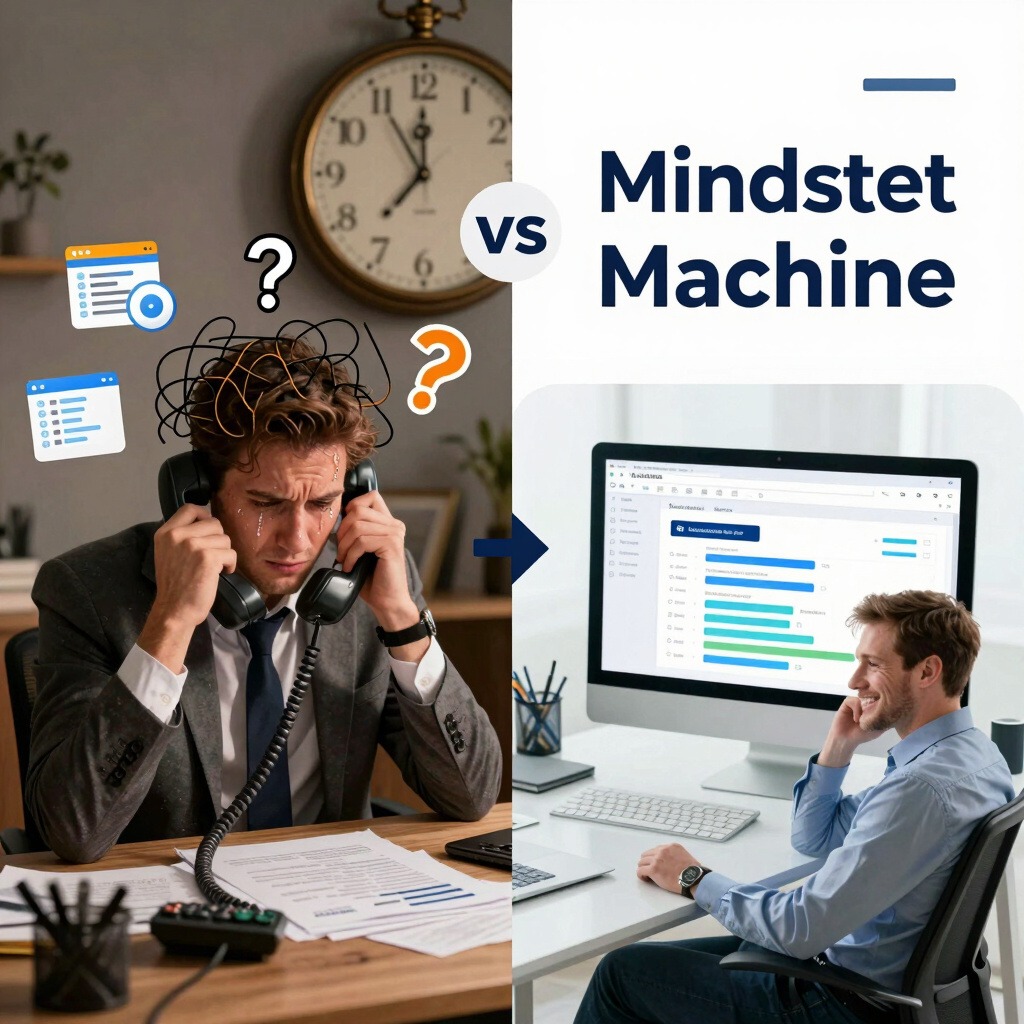
Here’s the kicker: this isn’t a story about lazy salespeople or broken processes. It’s about how your brain’s wiring is sabotaging your revenue.
Most sales leaders blame poor follow-up on motivation, training, or CRM adoption. But the real culprit? Your team’s mindset, creating invisible barriers that kill deals before they have a chance to close.
Today, we’re going to dissect why 44% of sales reps abandon leads after one attempt, how psychology explains your conversion rate plateau, and why AI SMS automation isn’t just a “nice-to-have,” but the mental offload your team desperately needs to break through revenue ceilings.
The Hidden Psychology Behind Your Follow-Up Failures
Why 44% of Sales Reps Stop After One Attempt (It’s Not Laziness)
Sales follow-up failure stems from predictable cognitive patterns, not character flaws or poor training.
According to research, while 80% of sales require at least five follow-ups to close, 44% of sales reps stop after just one attempt. But here’s what most sales leaders miss:
This isn’t about work ethic.
When Sarah decides not to follow up with that demo prospect, her brain is running a sophisticated cost-benefit analysis in the background.
She’s unconsciously weighing the psychological cost of potential rejection against the uncertain reward of a response. Each unreturned call or ignored email reinforces a mindset that says:
“This prospect isn’t interested.”
But we can’t blame Sarah. The human brain is wired to avoid negative feedback and conserve energy for activities with higher perceived success rates.
In sales psychology, this manifests as approach avoidance, the tendency to pursue leads that feel “warm” while unconsciously deprioritizing those that seem less responsive.
Think about your own team’s behavior.
How often do reps spend extra time crafting emails to prospects who’ve already shown interest, while letting “cold” leads sit in their CRM?
That’s not poor prioritization – that’s evolutionary psychology optimizing for emotional comfort over revenue potential.
The Mental Model Trap: How Your Brain Sabotages Persistence
Mindsets are mental shortcuts that help us make sense of complex situations, but in sales follow-up, they often create false narratives that affect consistency.
Your reps aren’t consciously deciding to give up on leads. Instead, they’re operating from mindsets that make abandonment feel logical and justified.
Here are the three most dangerous mental models killing your conversion rates:
1. The “No Response Means No Interest” Model:
When prospects don’t respond immediately, reps interpret silence as rejection.
In reality, research shows that leads contacted within 5 minutes are 21 times more likely to convert than those reached after 30 minutes.
But most prospects aren’t sitting by their phone waiting for your call. They’re in meetings, dealing with crises, or simply overwhelmed by their inbox.
2. The “One Size Fits All Timing” Model:
Reps follow up based on their own schedule preferences rather than buyer psychology.
If Sarah prefers email communication and works best in the morning, she’ll email prospects at 9 AM.
But her prospect might be a mobile-first decision maker who checks messages during their evening commute. This timing mismatch gets interpreted as lack of interest rather than poor channel-time alignment.
3. The “Perfect Message” Model:
Reps spend excessive time crafting the “perfect” follow-up message, then feel defeated when it doesn’t generate an immediate response.
This perfectionism creates a psychological barrier to consistent action. The fear of sending an imperfect message often prevents sending any message at all.
These mindset feel rational in the moment but create systematic blind spots that compound over time.
A rep who operates with these mindsets will unconsciously filter their pipeline, focusing energy on leads that confirm their existing beliefs while neglecting those that could convert with proper persistence.
Decision Fatigue and the Mental Load of Manual Follow-Up
Every follow-up decision depletes mental energy, creating a mental block that scales poorly as lead volume increases.
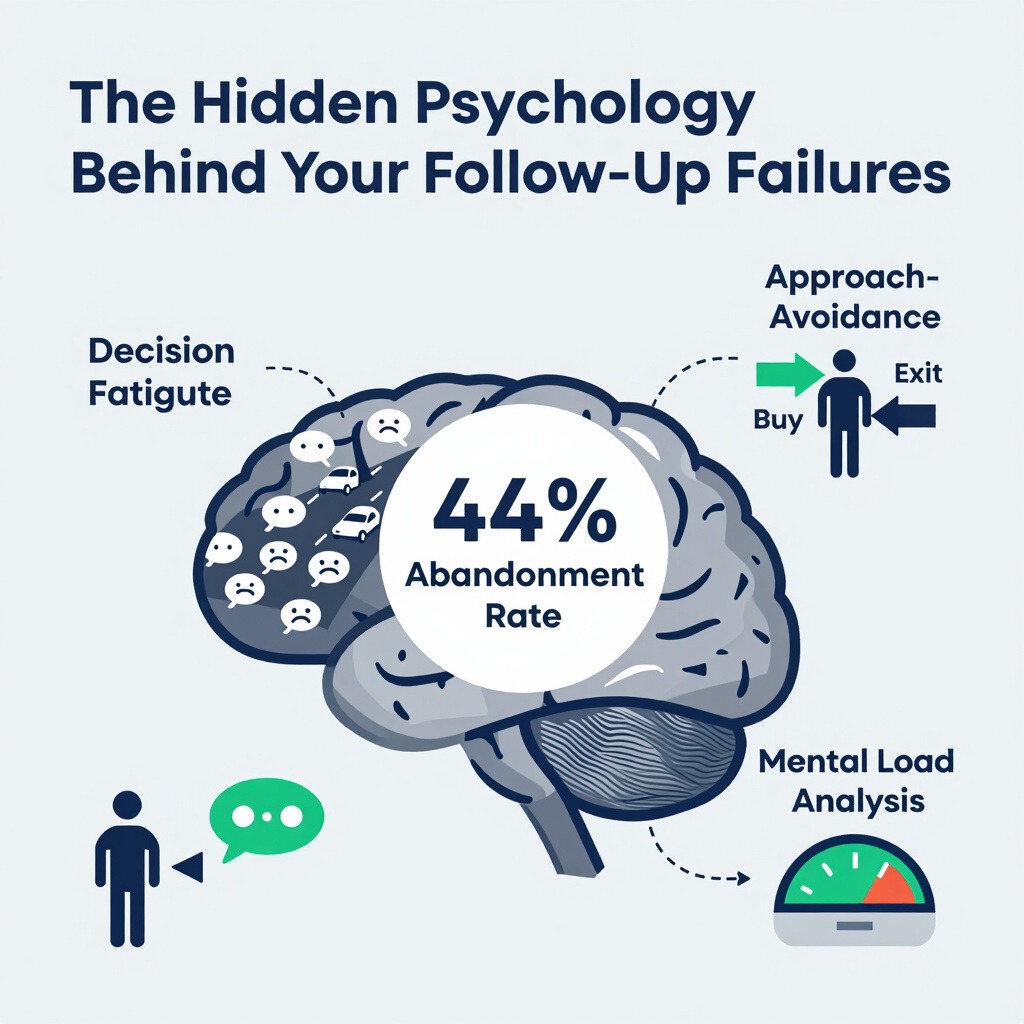
Decision fatigue isn’t just feeling tired after a long day; it’s the measurable decline in decision quality that occurs as mental resources get depleted.
Consider what happens in your rep’s brain during manual follow-up:
- Should I call or email this prospect?
- What time of day should I reach out?
- How long should I wait between attempts?
- What message will resonate with this specific person?
- Which leads deserve my limited time today?
Each of these micro-decisions requires mental processing power. Multiply this by 50-100 active prospects, and you’ve created a mental workload that guarantees inconsistent execution.
According to research from Roy Baumeister, decision fatigue follows a predictable pattern. Early in the day, people make thoughtful, strategic choices. As mental resources deplete, they either make increasingly poor decisions or avoid making decisions altogether.
In sales, this manifests as reps who start strong with morning follow-ups but abandon systematic outreach by afternoon.
The mental load problem gets worse with CRM systems that require manual data entry, task creation, and activity logging. What should be a simple “send follow-up message” becomes a multi-step workflow that increases friction and reduces consistency.
This is why even well-trained, motivated reps struggle with follow-up consistency. It’s not a willpower problem. It’s a mindset problem that requires systematic solutions rather than motivational speeches.
The 5-Minute Window: Why Speed-to-Lead Demands AI Intervention
The 21x Conversion Multiplier You’re Missing
Leads contacted within 5 minutes convert at 21 times the rate of those reached after 30 minutes, creating a mathematical imperative for automated response systems.
This isn’t marketing hyperbole; it’s data from Lead Response Management studies analyzing millions of lead interactions.
But here’s the reality check:
Your human reps cannot consistently respond within 5 minutes. Even your fastest, most dedicated salesperson needs time to:
- Notice the new lead notification
- Review the lead information
- Craft an appropriate response
- Send the message across the right channel
By the time this process completes, that 5-minute window has closed, and your conversion probability has dropped by 400% for every additional 10-minute delay.
The math is brutal but clear.
If your average lead response time is 30 minutes (which is actually better than most companies), you’re operating at less than 5% of your potential conversion rate simply due to timing.
Scale this across hundreds of monthly leads, and you’re looking at massive revenue leakage that compounds month after month.
This creates what I call the “Speed-Personalization Paradox.”
Fast responses increase conversion probability, but personalized messages require time to craft.
Most sales teams choose one or the other, sacrificing either speed or relevance. AI SMS automation solves this by delivering personalized messages at machine speed.
Human Response Times vs. Buyer Intent Windows
Buyer intent operates on a completely different timeline than human sales processes, creating a fundamental mismatch that kills deals before they begin.
When someone fills out a contact form, requests a demo, or downloads a whitepaper, they’re experiencing peak interest. That interest doesn’t stay constant. It decays rapidly as other priorities, competitors, and distractions enter their attention.
Think about your own behavior as a buyer:
When you submit a form requesting information about a product, you’re mentally prepared for that conversation right now. You’ve carved out mental space for evaluating solutions.
But if the vendor takes 2 hours to respond, you’ve moved on to other tasks. When they finally call, you’re in a completely different headspace.
Research from InsideSales shows that buyer intent follows a predictable decay curve:
- Minutes 0-5: Peak interest, maximum conversion probability
- Minutes 5-30: Rapid interest decline, distractions increase
- 30+ minutes: Competing priorities dominate attention, conversion drops 400%
Meanwhile, human sales processes operate on hour and day cycles:
- Lead notification: 5-15 minutes (if systems work perfectly)
- Rep availability: 30 minutes to 4 hours (meetings, calls, breaks)
- Response preparation: 10-30 minutes (research, message crafting)
- Actual contact: 1-6 hours from initial interest
This timeline mismatch isn’t a process problem you can train your way out of. It’s a fundamental constraint of human-operated sales systems that requires technological solutions to bridge the gap.
How AI SMS Eliminates the Speed-Personalization Tradeoff
AI SMS systems deliver personalized responses within seconds of lead capture, maintaining both speed and relevance without human intervention.
This isn’t about replacing your sales team – it’s about extending their capabilities to match buyer psychology.
Modern AI SMS platforms can analyze lead source, company data, and behavioral signals to craft contextually relevant messages that feel personal while operating at machine speed.
For example, when someone downloads a pricing guide from your website, an AI system can instantly send an SMS like:
“Hi [Name], saw you grabbed our pricing guide for [specific product]. Quick question – are you evaluating solutions for Q4 implementation or planning for next year? Either way, I can share some relevant case studies. – Sarah”
This message arrives within 30 seconds of the download, feels personal and relevant, and creates a natural conversation opener. Your human rep Sarah didn’t write it, but it authentically represents her voice and expertise.
The AI handles the speed requirement while maintaining personalization through:
- Dynamic content insertion based on lead source and company data
- Behavioral trigger responses that match specific actions to relevant messages
- Channel optimization that delivers messages via SMS, email, or phone based on prospect preferences
- Timing intelligence that schedules follow-ups based on response patterns and time zones
This eliminates the cognitive load of follow-up decisions while ensuring no lead falls through timing gaps. Your reps can focus their mental energy on high-value conversations rather than administrative follow-up tasks.
Why Your Current Follow-Up ‘System’ Is Actually No System at All
The Illusion of CRM-Driven Consistency
Most sales teams mistake CRM task management for systematic follow-up, creating the appearance of process while delivering inconsistent execution.
Your CRM might show perfect follow-up compliance in reports, but the reality is far messier.
Here’s what actually happens in most “systematic” follow-up processes:
Rep creates a follow-up task for next Tuesday at 2 PM. Tuesday arrives, but the rep is in back-to-back meetings until 4 PM. They see the overdue task, feel guilty, and reschedule it for Wednesday.
Wednesday comes with its own fires to fight. The task gets pushed to Thursday, then Friday, then “next week.”
Meanwhile, the prospect has moved on, engaged with competitors, or simply lost interest due to the delayed response. The CRM shows the task was “completed” when the rep finally makes contact, but the timing damage was already done.
This isn’t a training problem or a motivation issue. It’s a system design problem.
CRMs are built for tracking and reporting, not for ensuring optimal timing and consistency. They create the illusion of systematic follow-up while relying on human memory, availability, and decision-making for execution.
The cognitive burden of manual task management also creates what psychologists call “task switching costs.”
Every time a rep moves from a sales call to checking CRM tasks to crafting follow-up messages, their brain needs time to context-switch. These micro-transitions add up to significant productivity losses and increased mental fatigue.
Real systematic follow-up requires removing human decision-making and timing dependencies from the critical path. The system should execute regardless of individual availability, mood, or competing priorities.
Confirmation Bias: Why Reps Ignore Unresponsive Leads That Would Convert
Sales reps unconsciously prioritize leads that confirm their existing beliefs about “good prospects,” systematically neglecting leads that could convert with proper nurturing.
This confirmation bias creates invisible revenue leaks that compound over time.
Here’s how it plays out:
Sarah has two leads in her pipeline. Lead A responded enthusiastically to her initial outreach and scheduled a demo. Lead B hasn’t responded to two follow-up attempts. Sarah’s brain categorizes Lead A as “hot” and Lead B as “cold.”
Over the next week, Sarah spends extra time preparing for Lead A’s demo, crafting thoughtful follow-up emails, and researching their company. Lead B gets a generic “checking in” email, if anything.
Plot twist:
Lead A is early in their buying process and won’t purchase for 8 months. Lead B is actively evaluating solutions but prefers phone calls over email and works non-traditional hours. With proper persistence and channel optimization, Lead B would convert in 30 days.
But Sarah’s confirmation bias prevents her from investing equal energy in Lead B. She interprets lack of email response as lack of interest, rather than channel or timing mismatch.
This mentality feels logical but systematically undervalues prospects who don’t match her communication preferences.
Many studies have shown that a significant number of deals come from prospects who were initially unresponsive to first contact attempts. These “sleeper” leads require different nurturing approaches but often convert at higher rates once engaged.
Confirmation bias also affects lead scoring and prioritization. Reps give higher priority to leads that “feel” like good prospects based on initial interactions, rather than objective conversion probability.
This emotional prioritization leaves money on the table by abandoning leads that would respond to different approaches.
Sunk Cost Fallacy in Lead Prioritization
Sales reps continue investing time in low-probability prospects simply because they’ve already invested effort, while abandoning higher-potential leads that require fresh energy.
This sunk cost fallacy reverses optimal resource allocation and reduces overall pipeline efficiency.
The psychology works like this:
Sarah has spent 3 hours researching and following up with a prospect who keeps rescheduling demos. Rationally, this prospect is showing low buying intent through their actions. But Sarah’s brain focuses on the time already invested rather than future probability of success.
Meanwhile, fresh leads enter her pipeline that could convert quickly with proper attention. But Sarah feels compelled to “finish what she started” with the problematic prospect, leaving new opportunities under-nurtured.
This creates a backward-looking prioritization system where past effort drives future effort, rather than forward-looking probability assessments. Reps get trapped in low-conversion activities while high-potential opportunities receive minimal attention.
The sunk cost fallacy is particularly dangerous in sales because it feels responsible and persistent.
Sarah believes she’s being thorough and professional by continuing to pursue difficult prospects. In reality, she’s optimizing for effort rather than outcomes.
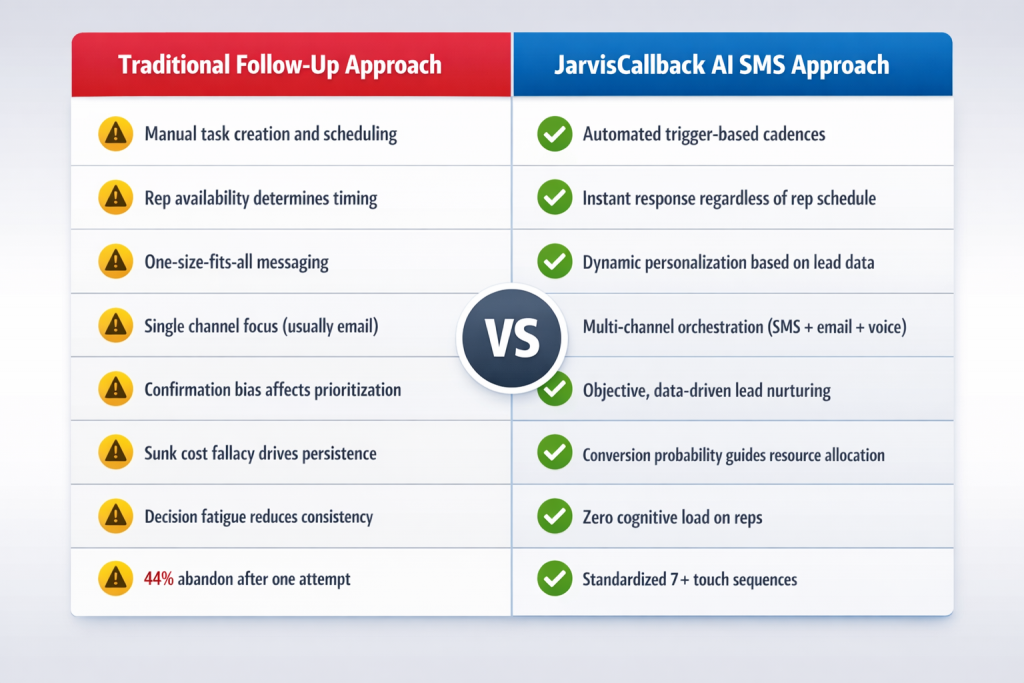
AI SMS Follow-Up: The Cognitive Offload Your Team Needs
Automated Persistence Without Decision Fatigue
AI SMS systems eliminate the mental burden of follow-up decisions while maintaining systematic persistence that humans cannot sustain consistently.
This isn’t about replacing human judgment – it’s about removing routine decisions that drain mental energy and create execution gaps.
When JarvisCallback handles automated follow-up sequences, your reps never face the “should I follow up today?” decision. The system executes predetermined cadences based on lead behavior, timing optimization, and conversion data.
This removes decision fatigue from the equation while ensuring no lead falls through cracks due to competing priorities or mental overload.
The cognitive offload effect extends beyond simple task automation. When reps know the system is handling consistent follow-up, they can focus their mental energy on high-value activities like discovery calls, demo preparation, and deal strategy.
This creates a virtuous cycle where human cognitive resources get allocated to activities that genuinely require human intelligence and creativity.
Research shows that reducing routine decision-making by just 20% can improve complex problem-solving performance significantly.
In sales contexts, this means reps who aren’t mentally drained by follow-up logistics perform better on calls, craft more compelling proposals, and close deals more effectively.
The automation also eliminates the psychological friction of rejection sensitivity. When an AI system sends follow-up messages, reps don’t experience the emotional impact of non-responses.
This removes the unconscious avoidance behaviors that cause human-driven follow-up to decay over time.
Real Conversion Data: 20-30% Lift from Standardized AI Cadences
Companies implementing AI-driven follow-up systems consistently report conversion rate improvements of 20-30% within 90 days, with ROI ranging from 5:1 to 841:1 depending on average deal size.
These aren’t vendor-reported vanity metrics. They’re audited results from companies that replaced manual follow-up with systematic automation.
The conversion lift comes from three sources:
1. Timing Optimization:
AI systems respond within minutes rather than hours, capturing leads during peak interest windows. This alone typically accounts for 15-20% of the conversion improvement.
2. Persistence Consistency:
Automated sequences ensure every lead receives multiple follow-up attempts, eliminating the 44% abandonment rate that plagues human-driven processes. This adds another 10-15% to conversion rates.
3. Message Optimization:
AI systems can A/B test message variations and optimize for response rates automatically, while humans tend to stick with familiar approaches regardless of performance data.
A mid-market SaaS company implementing JarvisCallback’s automated follow-up system saw their lead-to-opportunity conversion rate increase from 12% to 18% within 60 days.
With 500 monthly leads and an average deal size of $25,000, this 6-percentage-point improvement generated an additional $750,000 in quarterly pipeline.
The ROI calculation is straightforward: the cost of AI SMS automation (typically $200-500 per month) compared to the revenue impact of improved conversion rates. Even conservative improvements of 15-20% typically generate ROI of 10:1 or higher for companies with mature sales processes.
Building a Mentality That Scales: Implementation Framework
Mapping Your Current Follow-Up Failure Points
Systematic follow-up improvement starts with honest assessment of where your current process breaks down, focusing on mental and timing failures rather than just procedural gaps.
Most sales audits focus on what reps should do differently, but effective diagnosis examines why current approaches fail consistently.
Start by tracking these key failure points in your existing process:
1. Response Time Analysis:
Measure actual response times from lead capture to first contact attempt.
Don’t rely on CRM timestamps, use lead source data to calculate real elapsed time.
Most companies discover their “fast” response times are actually 2-4 hours, missing the critical 5-minute conversion window entirely.
2. Follow-Up Sequence Decay:
Track how many leads receive 1, 2, 3, 4, and 5+ follow-up attempts.
Map this against your intended cadence to identify where human execution breaks down.
The typical pattern shows strong first-attempt compliance but rapid decay after the second contact.
3. Channel Effectiveness Mapping:
Analyze response rates by communication channel (email, phone, SMS, LinkedIn) and timing (day of week, time of day).
Most teams discover significant gaps between their preferred channels and prospect response patterns.
4. Cognitive Load Assessment:
Survey your reps about which follow-up tasks they find most mentally draining or time-consuming.
Common pain points include message personalization, timing decisions, and CRM data entry.
These mental friction points predict where automation will have the highest impact.
5. Conversion Velocity Analysis:
Measure time from lead capture to qualified opportunity for leads that convert.
Compare this to leads that don’t convert to identify timing patterns.
Fast-converting leads often show response patterns that can be replicated through systematic follow-up.
This diagnostic process reveals the difference between process problems (which training can fix) and systematic problems (which require technological solutions).
Most follow-up failures fall into the systematic category, making automation essential rather than optional.
Designing AI-Driven Cadences That Match Buyer Psychology
Effective AI follow-up sequences align message timing and content with predictable patterns in buyer decision-making, rather than arbitrary scheduling based on sales convenience.
This requires understanding how buyer interest and attention cycles work, then designing automated touchpoints that match these natural rhythms.
Buyer psychology research shows distinct phases in the evaluation process:
1. Immediate Interest Phase (0-24 hours):
Peak attention and openness to engagement. Messages should focus on quick value delivery and easy next steps. AI SMS works particularly well here because it matches the urgency of initial interest.
2. Research and Comparison Phase (1-7 days):
Buyers are actively evaluating options and gathering information. Follow-up should provide relevant resources, case studies, and differentiation points. Email works well for delivering substantial content.
3. Internal Socialization Phase (1-4 weeks):
Buyers are sharing information with colleagues and building internal consensus. Messages should provide tools that help with internal selling: ROI calculators, executive summaries, implementation timelines.
4. Decision and Approval Phase (2-8 weeks): Final evaluation and approval processes. Follow-up should address common objections, provide social proof, and create appropriate urgency without being pushy.
AI systems excel at delivering the right message type at the right phase automatically.
For example, JarvisCallback can trigger immediate SMS responses for new leads, shift to educational email sequences after 24 hours, and escalate to human reps when behavioral signals indicate decision-phase activity.
The key is mapping your specific buyer journey to automated touchpoint sequences, then testing and optimizing based on actual response and conversion data rather than assumptions about what “should” work.
Measuring What Matters: Response Rates, Conversion Velocity, and ROI
Successful AI follow-up implementation requires tracking metrics that directly correlate with revenue outcomes, not just activity volumes or engagement vanity metrics.
Most companies measure the wrong things, leading to optimization around busy work rather than business results.
Primary Metrics (Revenue Impact):
- Lead-to-opportunity conversion rate by source and timeframe
- Average time from lead capture to qualified opportunity
- Pipeline velocity improvement (shorter sales cycles)
- Revenue per lead by follow-up sequence type
- Cost per acquired customer including follow-up automation costs
Secondary Metrics (Process Optimization):
- Response rate by channel and timing
- Sequence completion rates (how many leads receive full cadence)
- Human handoff conversion (when AI escalates to reps)
- Message optimization performance (A/B test results)
- Rep time savings and productivity improvements
Diagnostic Metrics (System Health):
- Technical delivery rates (messages actually sent vs. intended)
- Opt-out and complaint rates by message type
- Lead quality scores and source attribution
- Integration accuracy between systems
- Escalation trigger effectiveness
The most important insight is measuring conversion velocity:
How quickly leads move from initial interest to qualified opportunity.
AI follow-up typically reduces this timeframe by 40-60% while maintaining or improving conversion quality.
This velocity improvement often has more revenue impact than raw conversion rate increases because it accelerates cash flow and reduces competitive risk.
Track ROI monthly rather than quarterly to maintain momentum and identify optimization opportunities quickly. The payback period for AI SMS automation is typically 30-60 days, making this a fast-feedback investment decision.
Case Study: From 44% One-Touch Failure to 80%+ Multi-Touch Engagement
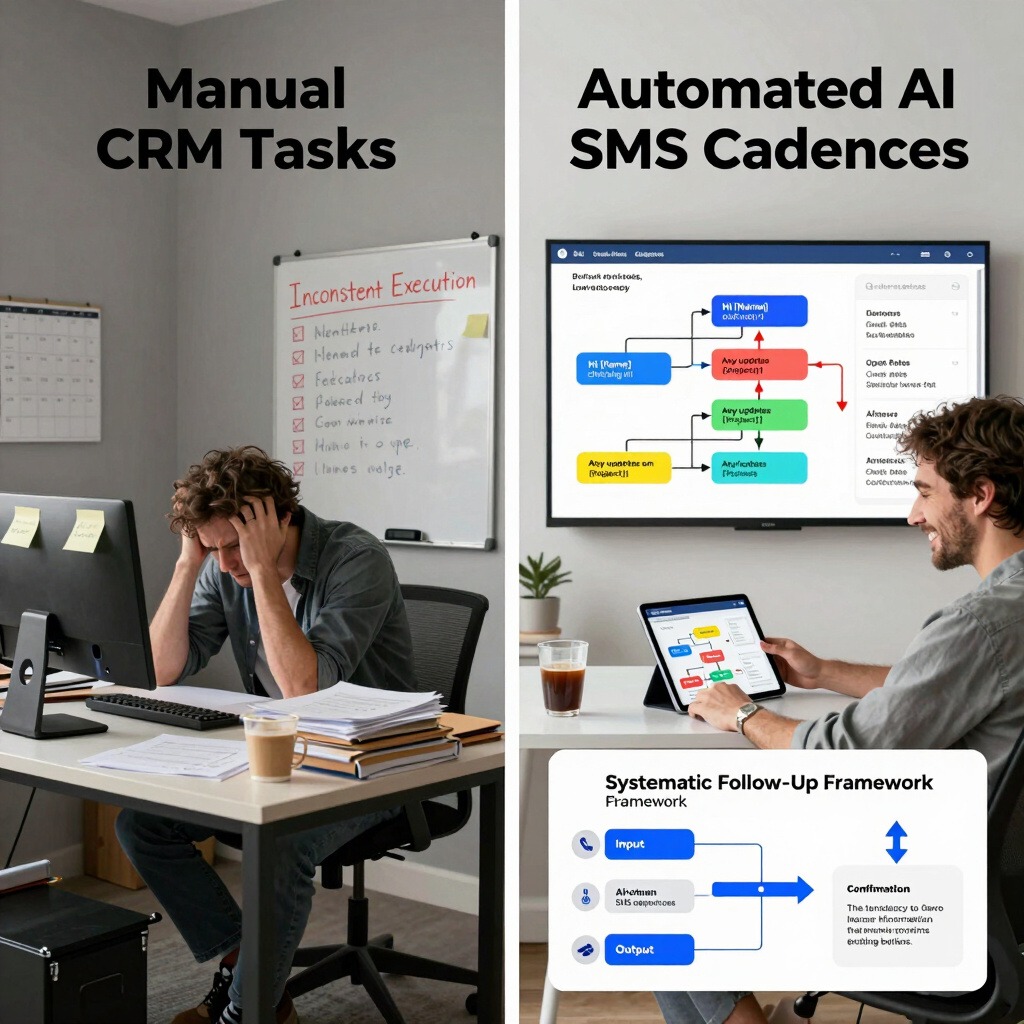
The Before State: Manual CRM Tasks and Inconsistent Execution
A mid-market software company was struggling with a classic follow-up problem that’s probably familiar to your organization. Despite having a well-trained sales team of 12 reps and a sophisticated CRM system, their lead-to-opportunity conversion rate had plateaued at 11% for over 18 months.
The surface-level metrics looked reasonable. Their CRM showed 85% follow-up task completion rates, and sales managers reported good activity levels during weekly pipeline reviews. But when we dug deeper into the actual execution data, a different story emerged.
The Reality Behind the Reports:
- Average response time to new leads: 3.2 hours (missing the 5-minute conversion window entirely)
- 47% of leads received only one follow-up attempt despite company policy requiring five touches
- Follow-up consistency varied dramatically by rep, with top performers averaging 4.1 attempts per lead while others averaged 1.8
- SMS was completely absent from their follow-up strategy, despite 73% of their target buyers being mobile-first executives
The Cognitive Load Problem:
Each rep was managing 60-80 active prospects manually, creating an impossible mental burden. The daily decision load included:
- Which leads to prioritize for follow-up
- What time to contact each prospect
- Which channel to use for each touchpoint
- How to personalize messages for different industries
- When to escalate or abandon leads
The sales reps were spending 2-3 hours per day just managing follow-up logistics.
They’d start the day with good intentions, but by afternoon they were mentally exhausted and defaulting to easy tasks like updating CRM records instead of making calls.
The team was caught in a classic decision fatigue spiral. Early morning follow-ups were thoughtful and consistent, but execution quality deteriorated throughout the day.
By week’s end, most reps were behind on their intended cadences and feeling overwhelmed by the accumulated task backlog.
The AI SMS Transformation: Automated 5-Minute Responses and 7-Touch Cadences
The company implemented JarvisCallback’s AI SMS automation system with a focus on eliminating mental load while maintaining personalization quality. The transformation wasn’t just about adding SMS to their stack; it was about completely redesigning their follow-up mindset.
The New System Architecture:
- Instant Response Layer: All new leads receive personalized SMS within 2 minutes of form submission, regardless of rep availability
- Multi-Channel Orchestration: 7-touch sequence combining SMS, email, and phone across 21 days
- Behavioral Triggers: System adapts based on prospect engagement, escalating hot leads to reps immediately
- Mental Offload: Reps focus on conversations and deal progression, not follow-up logistics
Sample Automated Sequence:
- Minute 2: SMS – “Hi [Name], saw you downloaded our ROI calculator. Quick question – are you evaluating solutions for this quarter or planning ahead? – Jennifer”
- Day 1: Email with relevant case study based on company size and industry
- Day 3: SMS follow-up referencing specific challenge mentioned in downloaded content
- Day 7: Automated phone call with personalized voicemail
- Day 10: Email with implementation timeline and pricing overview
- Day 14: SMS with limited-time consultation offer
- Day 21: Final email with competitive differentiation points
The AI system handles message personalization using company data, lead source information, and behavioral signals. Each touchpoint feels individually crafted while operating at scale impossible for human teams.
The Cognitive Relief Effect:
Within two weeks of implementation, reps reported significant mental energy improvements.
Instead of starting each day with follow-up decision paralysis, they began with a clean slate focused on high-value activities:
Discovery calls, demo preparation, and deal strategy.
Rep productivity metrics showed the impact:
- 40% increase in discovery calls booked per week
- 25% improvement in demo-to-proposal conversion rates
- 60% reduction in time spent on follow-up administration
- Significant improvement in rep satisfaction and energy levels
Results: 37% Conversion Rate Increase and 5:1 ROI in 90 Days
The transformation results exceeded the company’s expectations and provided clear validation for the AI SMS approach:
Conversion Rate Improvements:
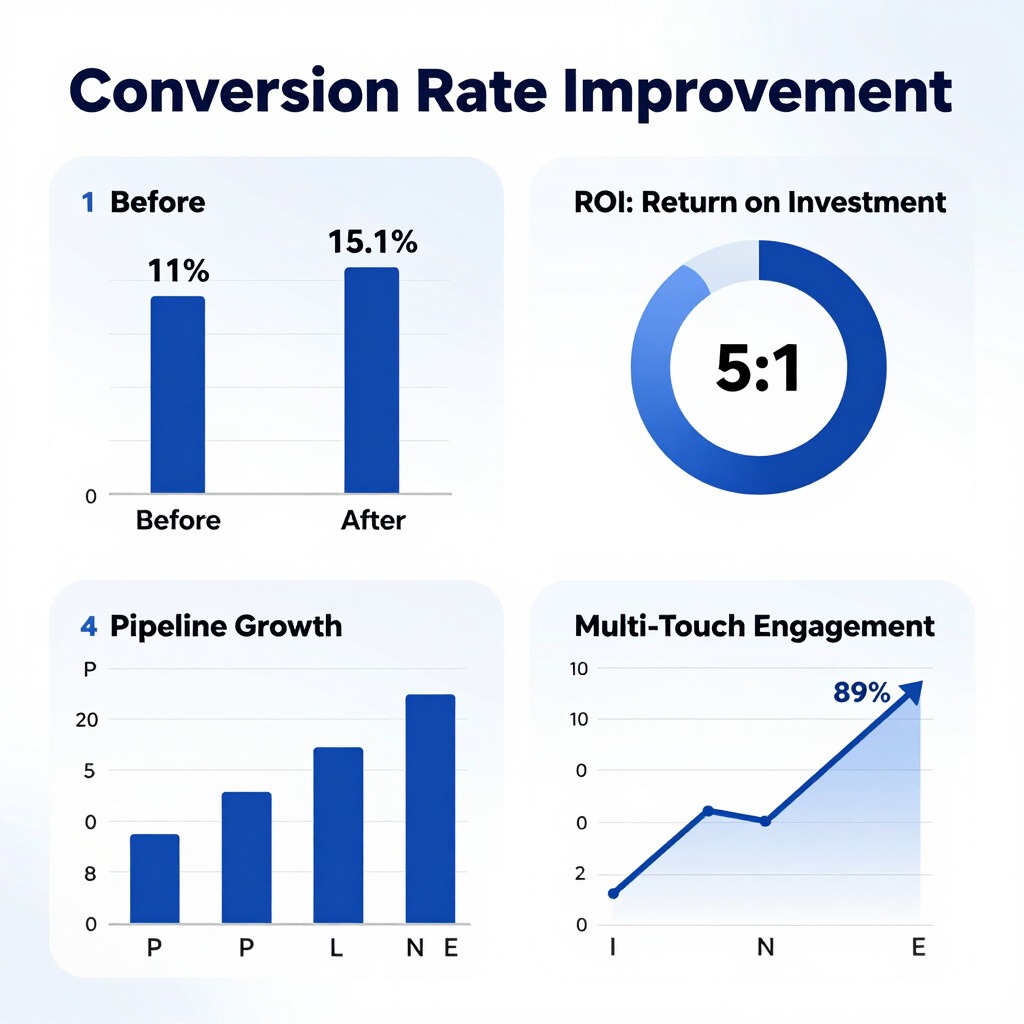
- Lead-to-opportunity conversion: 11% → 15.1% (37% increase)
- Response rate to initial outreach: 23% → 41% (78% increase)
- Multi-touch engagement: 44% → 83% (89% increase)
- Average touches per converted lead: 2.1 → 4.7 (124% increase)
Velocity and Efficiency Gains:
- Average response time: 3.2 hours → 2 minutes (99% improvement)
- Time from lead to qualified opportunity: 18 days → 11 days (39% faster)
- Rep productivity (calls per day): 12 → 19 (58% increase)
- Pipeline quality score: 6.2 → 8.1 (31% improvement)
Revenue and ROI Impact:
- Monthly qualified pipeline: $1.2M → $1.8M (50% increase)
- Quarterly revenue attribution: $340K additional closed deals
- System cost: $450/month for AI SMS automation
- ROI: 5.2:1 in first 90 days
The Unexpected Benefits:
Beyond the direct conversion improvements, the company discovered several secondary benefits that amplified their results:
- Competitive Advantage:
Fast SMS responses created a premium experience that differentiated them from slower competitors.
- Lead Quality Intelligence:
Behavioral data from automated sequences helped identify highest-intent prospects for rep prioritization.
- Scaling Capability:
The system handled lead volume spikes during marketing campaigns without additional headcount
- Rep Retention:
Reduced administrative burden and improved success rates increased job satisfaction and reduced turnover.
The transformation was massive. The company didn’t just add SMS to its process, it completely changed how the team thinks about follow-up.
Instead of hoping reps will execute consistently, we built a system that executes perfectly every time. The sales reps can focus on what humans do best: building relationships and closing deals.
The case study demonstrates that AI SMS automation is a productivity tool and a fundamental upgrade to sales team cognitive architecture that removes psychological barriers preventing consistent execution.
Conclusion
Your follow-up problem isn’t really a follow-up problem. It’s a mindset problem disguised as an execution challenge.
When 44% of sales reps abandon leads after one attempt, despite knowing that 80% of sales require five or more touches, we’re not looking at a training gap or motivation issue.
We’re seeing the predictable result of human mental structure colliding with the demands of modern sales velocity.
The solution isn’t better CRM training, more motivational meetings, or stricter accountability measures. It’s recognizing that consistent, optimally-timed follow-up requires removing human decision-making from the critical path.
AI SMS automation like JarvisCallback replaces your sales team’s judgment, and it eliminates the cognitive friction that prevents them from executing at their best.
Ready to eliminate the mental model barriers killing your conversion rates?
Schedule a JarvisCallback demo to see how AI SMS automation can transform your follow-up consistency and unlock the revenue potential hiding in your existing pipeline.